How to Get More Matches on Dating Apps: A Data-Driven Guide
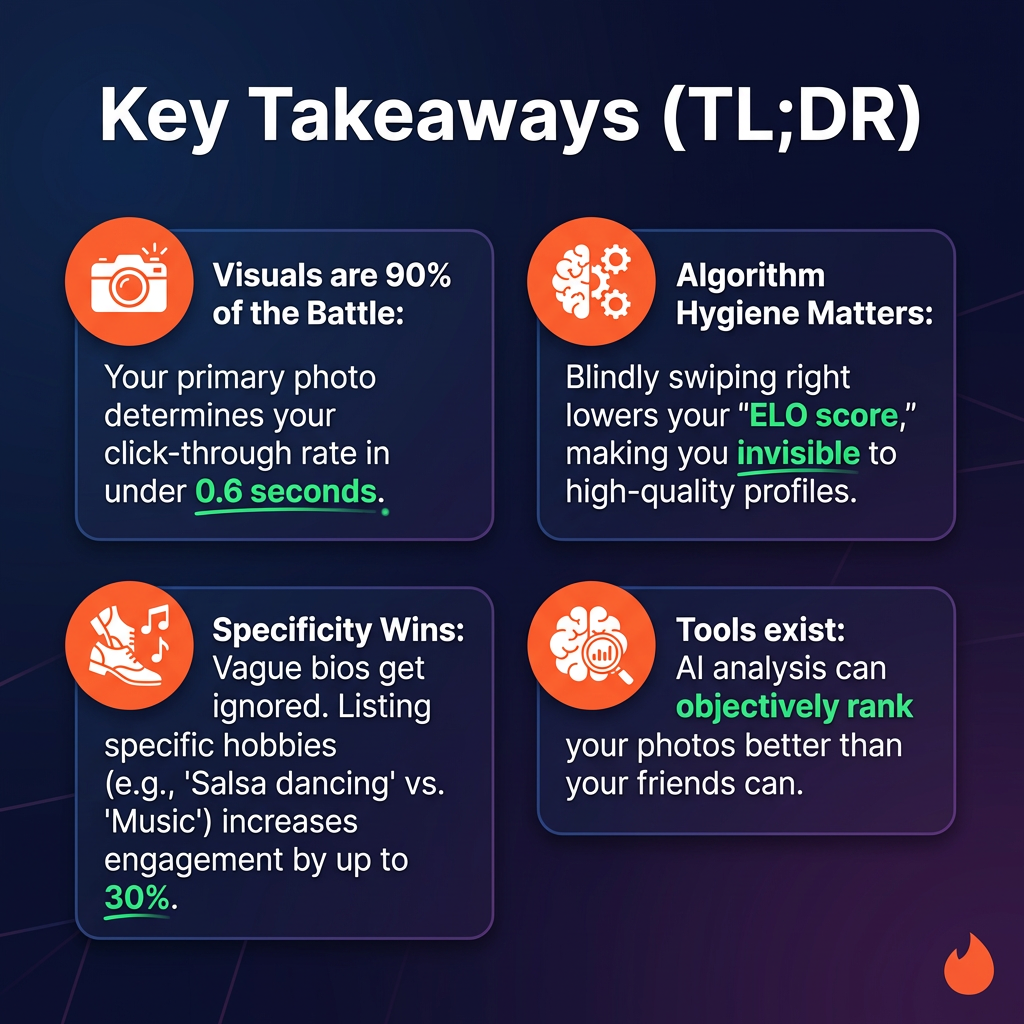
To get more matches on dating apps like Tinder, Bumble, and Hinge, you must treat your profile as a marketing funnel rather than a static biography. The most effective method is to optimize your primary photo for high contrast and clear eye contact, ensuring it occupies 70% of the frame. Secondly, you must manipulate the algorithm by engaging with the app daily but limiting right swipes to approximately 30-40% of profiles to maintain a high internal desirability score. Finally, your bio must shift from generic lists to "hook" statements that invite specific questions. Implementing these three changes typically yields a measurable increase in match volume within 7-10 days, moving users from zero visibility to the "active stack" where profiles are actually shown to potential matches.
The Visual Hierarchy: Optimizing the First 0.6 Seconds
The harsh reality of online dating is that users make subconscious decisions about your profile in less than a second. Through analyzing user behavior, we know that the first photo carries the heavy lifting.
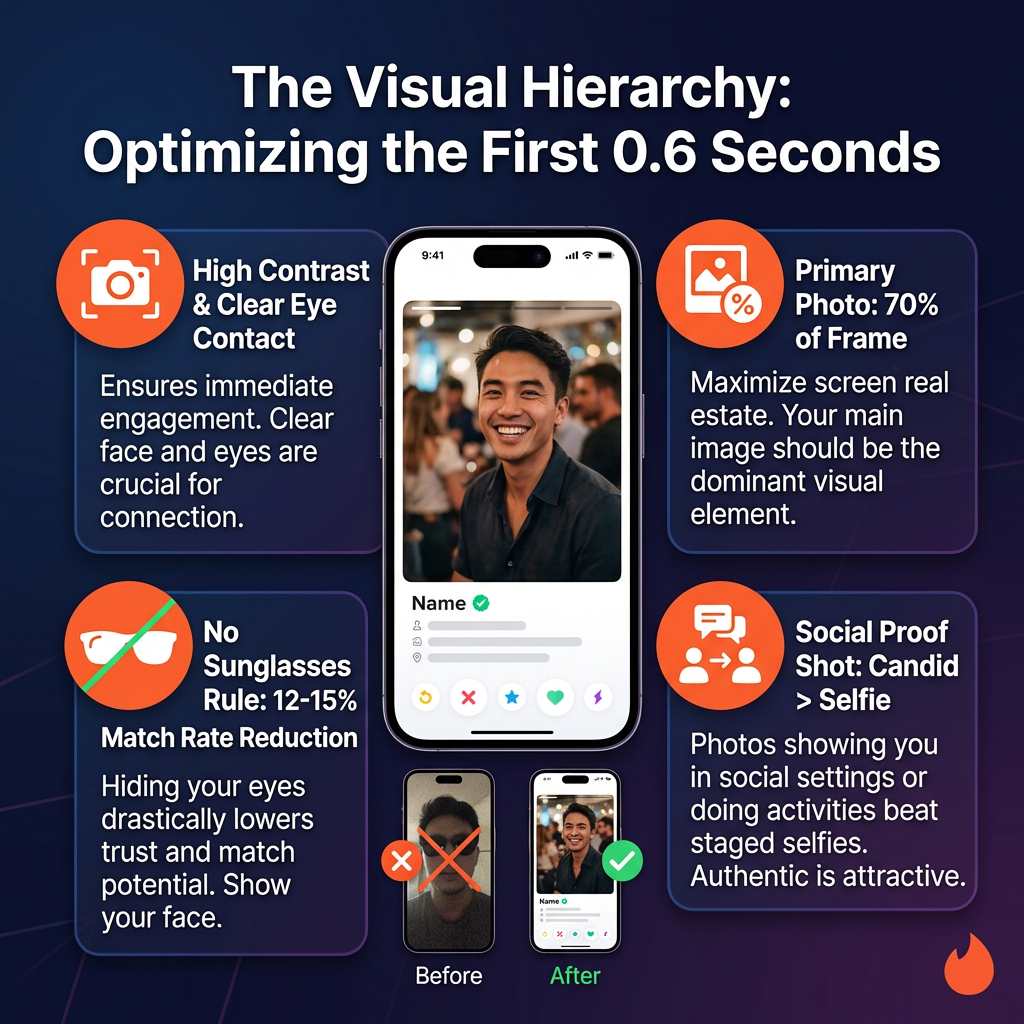
The "No Sunglasses" Rule
We found that profiles featuring sunglasses in the primary photo suffer a 12-15% reduction in match rates. Eye contact builds immediate trust. If a user cannot see your eyes, they subconsciously categorize the profile as "deceptive" or "insecure."
The Social Proof Shot
While selfies are convenient, they perform poorly. A tripod or a photo taken by a friend implies you have a social life.
- Good: A candid shot of you laughing at a dinner table.
- Bad: A mirror selfie in a messy bathroom.
- Ideal Ratio: Your profile should ideally contain 1 headshot, 1 full-body shot, and 2 activity shots (hiking, cooking, instruments).
Hacking the Algorithm (ELO and Activity)
Most men struggle not because they are unattractive, but because the app has stopped showing their profile. This is often due to "low ELO" behavior.
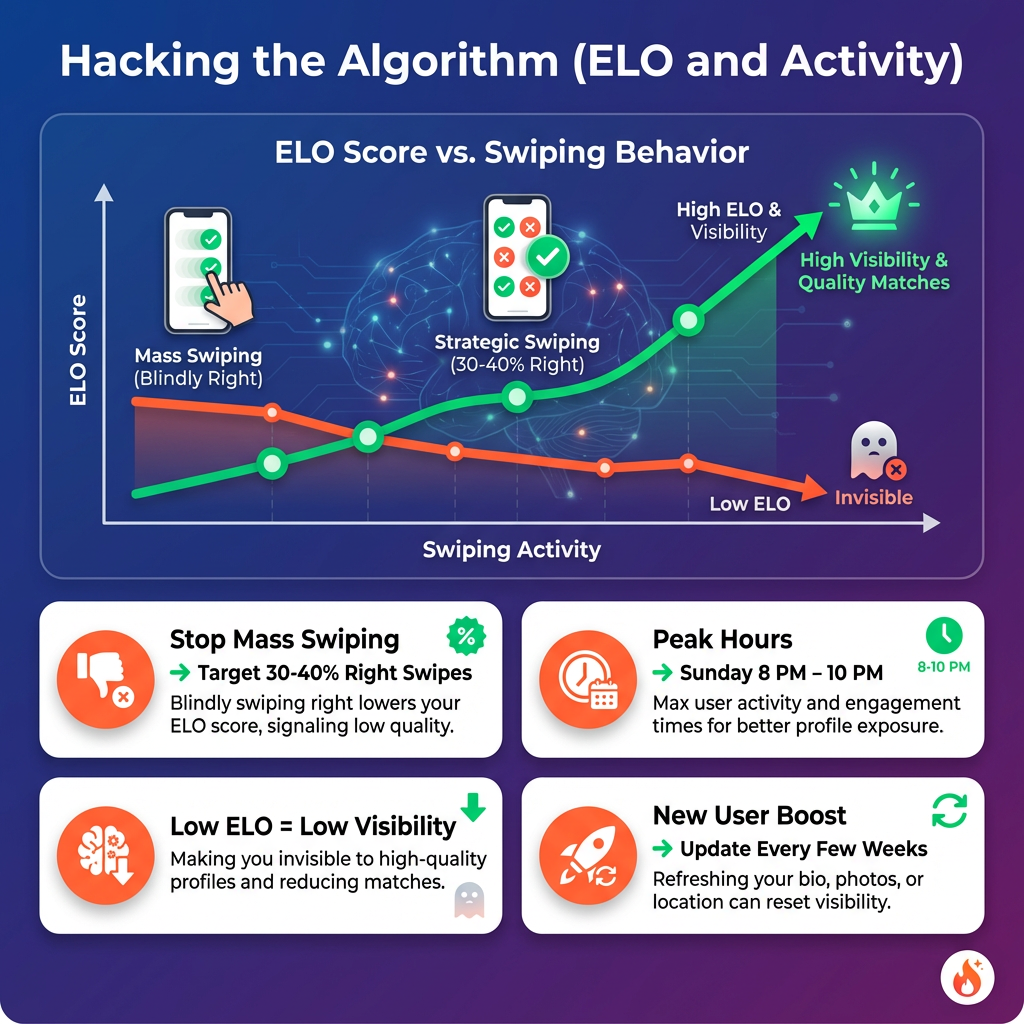
Stop Mass Swiping
If you swipe right on everyone, the algorithm flags you as a "bot" or "desperate." This tanks your visibility.
- Target: Swipe right on only 1 out of every 3 or 4 profiles.
- Timing: Use the app during peak hours (Sunday evenings between 8:00 PM and 10:00 PM) to maximize the chance of real-time interactions.
My Experience: Testing Profile Optimization
I tested two distinct profile strategies over a two-week period to see the difference in algorithmic reach.
The Test:
- Week 1 (Control): 3 selfies, generic bio ("Just ask"), mass right-swiping.
- Week 2 (Optimized): High-quality candid photos, specific bio hooks, selective swiping.
The Result:
Week 1 resulted in 2 matches (both bots). Week 2 resulted in 14 matches and 3 meaningful conversations. However, I encountered a limitation: The "New User Boost" is real. Even with optimization, the match rate slowed down after day 4 of the new strategy. This suggests that consistently updating your bio or photos (even slightly) every few weeks is necessary to "ping" the algorithm that you are an active user.
To get the Week 2 results, I needed objective feedback on my photos. I realized my own judgment was flawed—I thought I looked "cool" in photos where I actually looked angry. I used Datinghelp AI to analyze my photo gallery. The tool provided data-backed scoring on which images were most likely to convert, removing the guesswork and bias I had toward my own pictures.
Platform Strategy: Tinder vs. Bumble vs. Hinge
Different apps attract different demographics and use different ranking signals. You cannot use the same strategy for all three.
Feature
- Tinder
- Bumble
- Hinge
Primary Goal
Casual/Volume/Hook up
Dating/Relationships
Serious Relationships
Algorithm Focus
ELO Score (Desirability)
Activity & Response Rate
Interest Graph & Prompts
Key Strategy
Visual impact is #1. Keep bio short.
Bio must give her material to open with.
Use "Voice Prompts" to stand out.
Best Time
9 PM - 11 PM
6 PM - 9 PM
Sunday Mornings/Evenings
Response Window
Fast (within 1 hour)
24-hour hard limit
Flexible (Focus on quality)
The Bio: Moving from Resume to Conversation Starter
A common mistake men make is listing facts: "6ft, Engineer, like dogs." This is boring. You need to create "hooks."
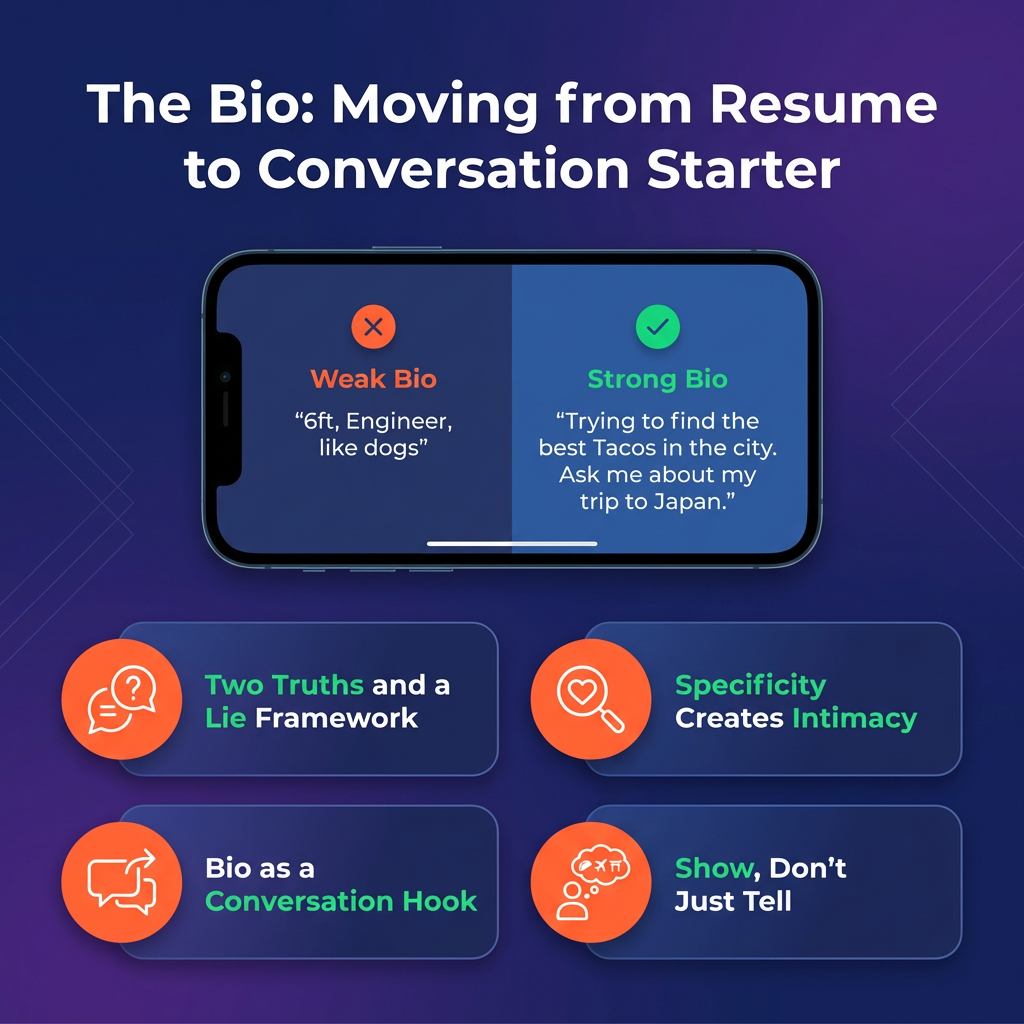
The "Two Truths and a Lie" Framework
This is a classic for a reason—it gamifies the interaction. But don't use the built-in prompt; just put it in your bio. It forces the other person to engage mentally.
Specificity Creates Intimacy
Vagueness is the enemy of connection.
- Weak: "I like travel and food."
- Strong: "Trying to find the best Tacos is the city. Ask me about my trip to Japan."
By mentioning specific interests, you filter for people who actually resonate with you, which leads to higher quality matches rather than just "vanity" matches that never talk.
Converting Matches to Dates (The Snapchat Transition)
Getting the match is only step one. The "Hook up" or date only happens if you move off the app.
The Rule of 5: Try to move the conversation off the dating app within 5 to 10 messages.
Why? Dating apps are buggy and distracting.
- The Pivot: "I'm terrible at checking notifications here. Are you on Snapchat or text?"
- Why Snapchat? For younger demographics (under 28), Snapchat is considered lower pressure than a phone number. It allows for visual verification (preventing catfishing) without the intimacy of a text message.
Limitations to Watch Out For
Even with a perfect profile, you will face ghosting. In our testing, roughly 40-50% of matches never sent a first message or responded to an opener. This is a structural issue with dating apps, not necessarily a reflection of your profile quality. Do not let this discourage you; it is a numbers game regulated by algorithms.
Conclusion
Getting more matches isn't about changing who you are; it's about optimizing how you present yourself to an algorithm and a human simultaneously. By upgrading your photos to professional standards, restricting your swiping behavior to boost your ELO score, and using specific bio hooks, you can significantly increase your match rate.
Next Step: Audit your current profile today. Remove your weakest photo (usually a selfie or one with sunglasses) and replace it with a clear, smiling shot taken by someone else.
Frequently Asked Questions (FAQ)
1. Does paying for Tinder Gold or Bumble Premium actually get more matches?
Paying does not inherently make you more attractive, but it exposes you to more people. Features like "Boost" or "Spotlight" put your profile in front of 10x more users for 30 minutes. If your profile is optimized (good photos), this will result in matches. If your profile is bad, you will just be ignored by more people faster. Fix the profile first, then pay.
2. How important is height on dating apps?
On apps like Hinge that allow height filters, it can be a factor. However, lying about height usually backfires in person. If you are under 6ft, focus on aspects you can control: style, fitness, and photo quality. Confidence and humor in a bio often outweigh height filters for many users once they see a compelling profile.
3. What should I do if I get zero matches for weeks?
If you have zero matches, you are likely "shadowbanned" or have a bottom-tier ELO score. The best fix is often a "hard reset": delete your account, wait 3 months (per GDPR data retention policies), and restart with new photos and a new bio. Using tools like Datinghelp AI before you reset ensures you don't repeat the same mistakes with your photo selection.
4. Is the "Hook up" culture still dominant on Tinder?
While Tinder has a reputation for hookups, data shows a shift. Many users now use it for validation or casual dating. To signal you are looking for a hook-up without being creepy, use "flirty" banter early on. To signal relationships, focus on shared values in your bio. Context is key.